How It Works
- Home
- How it works
Vulcan technology – How it works
Vulcan is a physical water treatment system that does NOT use chemicals or salt. It does not change the chemical composition of the water. Instead, it changes the physical characteristics of the limescale crystals in a way that the limescale particles lose their adhesive power. Vulcan does not need to have direct contact with the water and sits outside of the pipe.
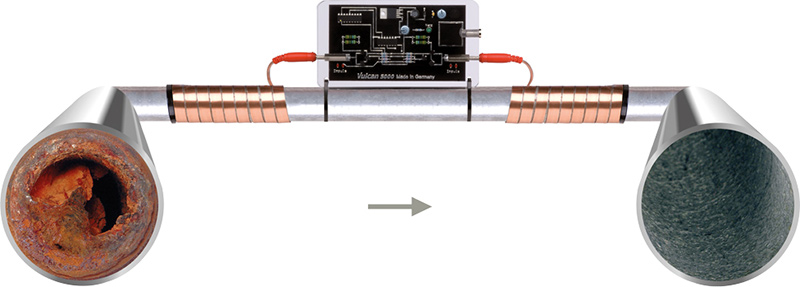
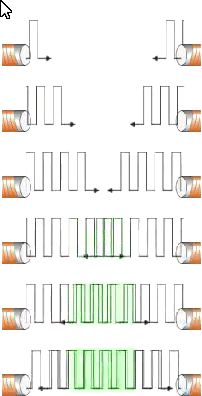
It treats the water with electric impulses which are generated in the electronic unit and are controlled by a computerized micro-chip. The signal-frequencies are transmitted via the Vulcan-impulse-bands that are wrapped around the pipe. The bands interact as pairs and form a frequency-field that changes the crystals in the water as it flows by.
Limescale causes many problems
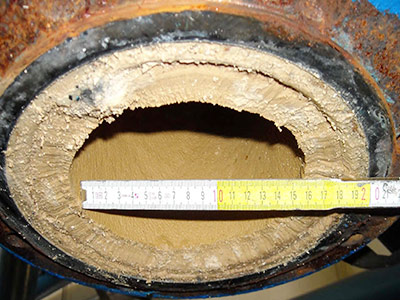
- Blocked piping systems
- Dull surfaces and malfunctioning machinery
- High costs for heating
- High expenses for cleaning
- Rust accumulation in the pipe that leads to corrosion
- Bacterial growth in drinking water carrying pipes
- Decrease in productivity
- and many more …
How does Vulcan help to solve these problems?
1. Vulcan reduces scaling in pipes and appliances
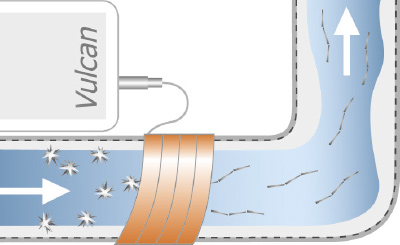
Without the Vulcan water treatment, the limescale particles in the water form sticky crystals that then build solid deposits. The patented Vulcan-Impulse-Technology modifies the crystallization of calcium and magnesium using the natural process of electrophoresis. The crystals become smoother and rod-shaped and can no longer attach to each other. Limescale is now washed away in the water as a fine powder. The formation of new deposits is stopped. The more rod-shaped crystals that are created, the stronger the positive effect of limescale-prevention.
Mono crystals as a result of the Vulcan water treatment
When mono-crystals are created by the impulse variation, it is important that they grow as long as possible before they start their way through the piping system. The larger the crystals, the longer it takes until the crystals fall apart again and eventually “die”. In warm water, these crystals grow faster and therefore are stronger and live longer. This explains why the Vulcan-effect lasts the longest in warm water (up to seven days) and shorter in cold water (approx. two days).
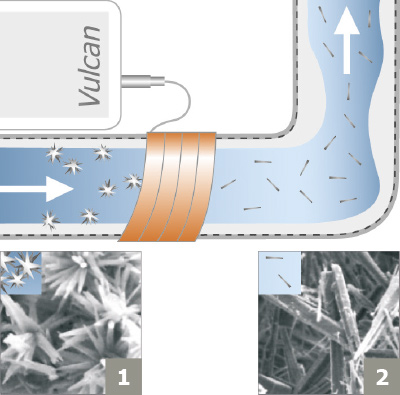
2. Vulcan gently sanitizes the piping system
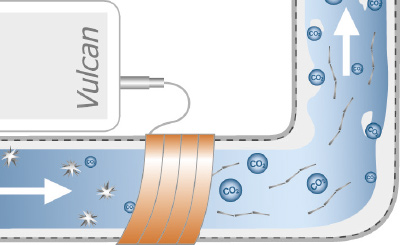
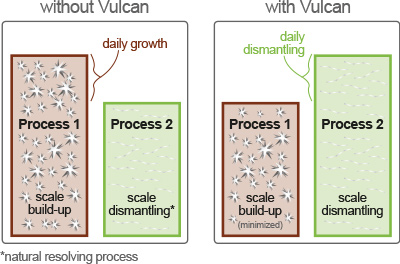
Two simultaneous processes take place in untreated, hard water: a. In the first process, limescale deposits result from calcium crystals adhering to each other which then adhere to surfaces. This first process produces carbonic acid (H2CO3) as a side product. b. During a second process, the carbonic acid simultaneously breaks down the existing limescale deposits. This is referred to as the “natural resolving process”. Because the build-up process takes place much faster than the natural resolving process the pipes’ diameter constantly decreases.
Ca(HCO3)2
calcium- hydrogen- carbonate
+
Vulcan
Vulcan impulse
-->
CaCo3
Mono- crystal
+
CO2
carbon dioxide
+
H2O
Water
The Vulcan water treatment changes the balance between the scaling process and natural resolving process. The mono crystals can no longer form deposits, therefore the limescale build-up of the first process is reduced. The natural limescale-resolving-process now needs only to deal with existing deposits and can effectively combat them. Thus limescale is removed faster than it forms. The natural surplus of carbonic acid dissolves the limescale from the limescale. Gradually and carefully, the deposits in the pipes will be removed.
The reduction of scale = the reduction of rust
As soon as limescale deposits have built up, iron particles imbed into it. Thus, the limescale and the rust blend into one material that are seen as red-colored deposits in the pipe. When the Vulcan treatment dismantles the scale, it simultaneously reduces also rust with it. Clearing out the deposits is a gentle process where limescale is brought back into solution and washed out in the water as: calcium, magnesium and iron. It is absolutely save to drink as these are all healthy minerals.
The reduction of scale = the reduction of bacteria
We know that limescale acts as a breeding ground for bacteria and other unwanted substances. As soon as Vulcan is installed and the scale is reduced, the bacteria breeding ground is also reduced. This way, bacterial contamination is greatly reduced or even fully removed.
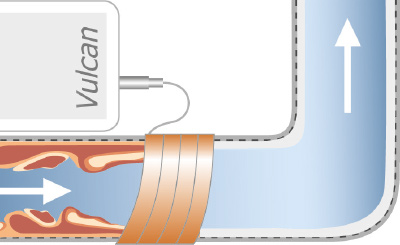
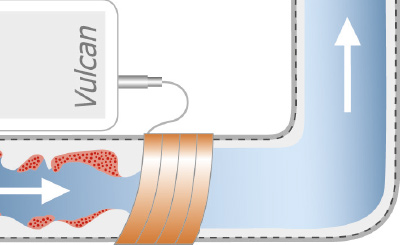
3. Vulcan protects against rust damage and perforation
Copper and/or iron oxidation occurs in all metal pipes through contact with calciferous (hard) water. These oxides seriously affect the pipe surfaces and may lead to corrosion. The Vulcan-impulse-technology generates an electrophoresis-effect which produces a protective metal-carbonate layer. According to the material of the pipe, this layer consists of copper-carbonate, iron-carbonate or zinc-carbonate and settles on all shiny metal surfaces. It protects the pipe from aggressive substances which could lead to corrosion.
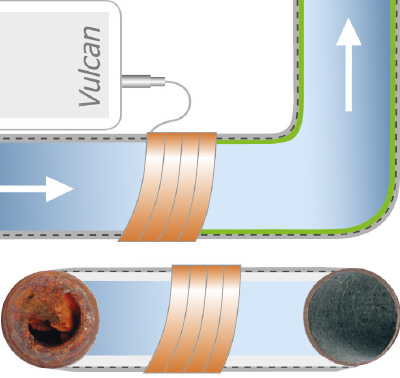
The Vulcan impulse bands
Vulcan operates with customized isolated copper impulse bands that are designed to firmly connect to the pipe. They are extremely thin and flexible with minimized isolation. This way, they achieve minimal spacing loss and maximize the direct-contact-ratio to 97.5%. Their special copper material with a high alloy purity degree guarantees the best possible transfer output. The copper treatment bands are a crucial factor to the performance of the water treatment.
The pipe diameter/treatment area ratio
The impulse bands cover the surface area that is vital for the treatment. The surface of the pipe that is covered by the impulse band is the “treatment area”. This area needs to be large enough to ensure that the impulses are transmitted through the pipe.
Treatment with standard cables vs. Vulcan impulse band
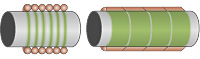
- Treatment Area
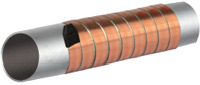
Comparison:
The Vulcan Impulse Bands accumulate more direct contact compared to round cables as there is less spacing. The direct contact ratio reaches 97,5%.
Scientific research
Physical Water Treatment – How It Works, by Dr. Ing. Jühnke
Steinbeis Institute: Test of Vulcan 5000
more studies & references
- Faqs
Frequently asked questions about Vulcan
Below are a few of the most frequently asked questions we have encountered. If, however, you do not find the answers you are looking for, we invite you to contact us directly and a representative will gladly get back to you.
Piping system
What type of pipe material does Vulcan treat?
Vulcan is suitable for all pipe materials: iron, galvanized iron, copper, steel, stainless steel, plastic, PVC, PE-X, compound pipes (any material mixture) etc.
Do plastic pipes and copper pipes need limescale protection at all?
Yes. Plastic and copper pipes are prone to calcifications, too. The smoother a surface is the longer it can resist the process of calcification. It may take longer until plastic or copper get a first layer of limescale. However, once that first layer has built up, the scaling process proceeds just as fast as on any other surface or material.
How long does it take Vulcan to sanitize the pipes?
Vulcan reduces limescale and rust without negatively affecting the pipes. The treatment works within the laws of nature. Therefore, the removal process may take as long as it took the deposits to develop.
Will the limescale that is cleaned out block the pipes?
No, the limescale is slowly dissolved back into a solution and the calcium and magnesium is washed away in the water as a fine powder.
How long does the effect last?
When mono-crystals are created by the impulse variation, it is important that they grow as long as possible before they start their way through the piping system. The larger the crystals, the longer it takes until the crystals fall apart again and eventually “die”. In warm water, these crystals grow faster and therefore are stronger and live longer. This explains why the Vulcan-effect lasts the longest in warm water (up to seven days) and shorter in cold water (approx. two days).
My copper pipes have turned green. Does Vulcan help with this problem?
Green colored copper pipes are an indication to oxidized copper or copper rust – similar to rust in iron pipes. The Vulcan treatment produces hydrogen dioxide (H2O2) which protects blank copper surfaces against oxidation. This way, Vulcan reduces the green colorization of the water.
Water quality
How do I know the water hardness of my water?
Your local waterworks provides detailed information on the chemical composition of your water. It lists the calcium and magnesium content and usually provides information on hardness in gpg (grains per Gallon) or in ppm (parts per million).
Up to which degree of water hardness can Vulcan be applied?
Vulcan operates within a high performance frequency range and is the only unit with a 36 Volt Technology. It can thus be successfully applied to problems with a very high degree of water hardness. Vulcan has successfully treated cases with a water hardness of 950 ppm (~approx. 55 GPG) or more.
Does the Vulcan treatment have a softening effect on the water?
The treatment does not change the overall water hardness. Unlike in chemical water treatment systems (e.g. a water softener that uses salt) the water treated by Vulcan does not lose minerals, such as calcium and magnesium. The natural composition of the elements in the water remains the same. However, due to a change of the water surface tension your skin will feel remarkably softer. You are sure to feel this effect when taking a shower or even simply washing your hands. Most importantly, limescale loses its adhesive characteristic. The treatment does not, however, change the measured water hardness. So on a chemical level you have the same hardness before and after the treatment.
Installation and operation
Is it difficult to install Vulcan in my home?
Vulcan is designed as a do-it-yourself product. It sits outside the pipe and you do not need to cut into the pipe. The installation is very easy and takes approx. 10 minutes. No tools required.
How do I know which size Vulcan is needed for my application?
Please check the pipe diameter in the area where you want to install Vulcan. Then choose the unit that is designed for this size.
Where should I install Vulcan in my home?
Vulcan is mounted outside of the pipe with no need to cut the pipe. It should be installed at the point where the incoming water supply line is going into the house. Most of the time this is close to the water meter. This way, a single Vulcan treats all the water pipes in the house. European homes usually have a basement, so the main water pipe sits somewhere there, inside the house.
Many homes allow access only outside the house. This again is usually where the water meter is located. Vulcan is a waterproof unit suitable for outdoor installation. We also offer a range of additional features such as a solar power charger in case that there is no power supply nearby.
How do I know that the Vulcan is operating efficiently?
Red pilot lights at the cable outputs indicate that the impulse generator is operating efficiently. In case these lights are not illuminated, please check the power supply voltage or contact your local distributor.
Which voltage ranges are suitable for the electronic power supply unit?
All Vulcan power supply units are suitable for voltage ranges between 87 Volt – 260 Volt and 50 Hz – 60 Hz. It can therefore easily caters to all international power plugs. We are glad to supply you with the correct power supply unit in case of an international relocation.
How many units do I need?
Private homes are taken care of with one unit that treats the whole house.
In larger buildings or industrial settings it depends. Typically, one larger unit gets installed on the incoming water supply line to the building. If you have a cooling tower or closed loop systems, another smaller unit would go there.
What are the power costs of Vulcan per year?
Vulcan is completely maintenance-free. The cost of electric energy per year amounts to approx. 5-7 US$ (~ 4-5 €).
Miscellaneous
How long has CWT been in business?
Christiani Wassertechnik dates back to the year 1948. The specialization in physical water treatment took place in 1977 when senior Managing Director, Rolf Christiani started research and development in this field. CWT is an owner-run company with three generations of family members spanning the history.
What kind of warranty do I get on Vulcan?
Vulcan has a full 25-year warranty and has a 30+ year life span. It is German TÜV-certified and is CE, CUL and UL listed. Your Vulcan unit is 100% covered under most circumstances. The units have an expected life of over 30 years and are imbedded in weather proof acrylic casts. By purchasing from the manufacturer and listed distributors, your warranty is well-assured. German quality standards and excellent customer service have been our priority for over 70 years.
I heard of similar products and that they don’ t work. Can you explain?
There are similar looking products to Vulcan on the market that claim to do the job, but don’t. Almost all other products on the market are working with inductive (electromagnetic) technologies. You can easily recognize them by their cables. Those cables run in a loop from the electronic unit – to the pipe and back into the unit. In comparison, Vulcan works exclusively with capacitive impulses that guarantee a stable output. Its impulse bands end on the pipes, similar to antennas. Furthermore, regardless of inductive or capacitive impulses: Vulcan utilizes far wider frequencies of 3,000 – 32,000 Hz (= 3-32 kHz) and operates with energy levels at 36 V.
Christiani Wassertechnik (CWT) is the oldest German manufacturer of physical water treatment. The product specialization in this field began in 1977 and we are constantly developing new technologies.